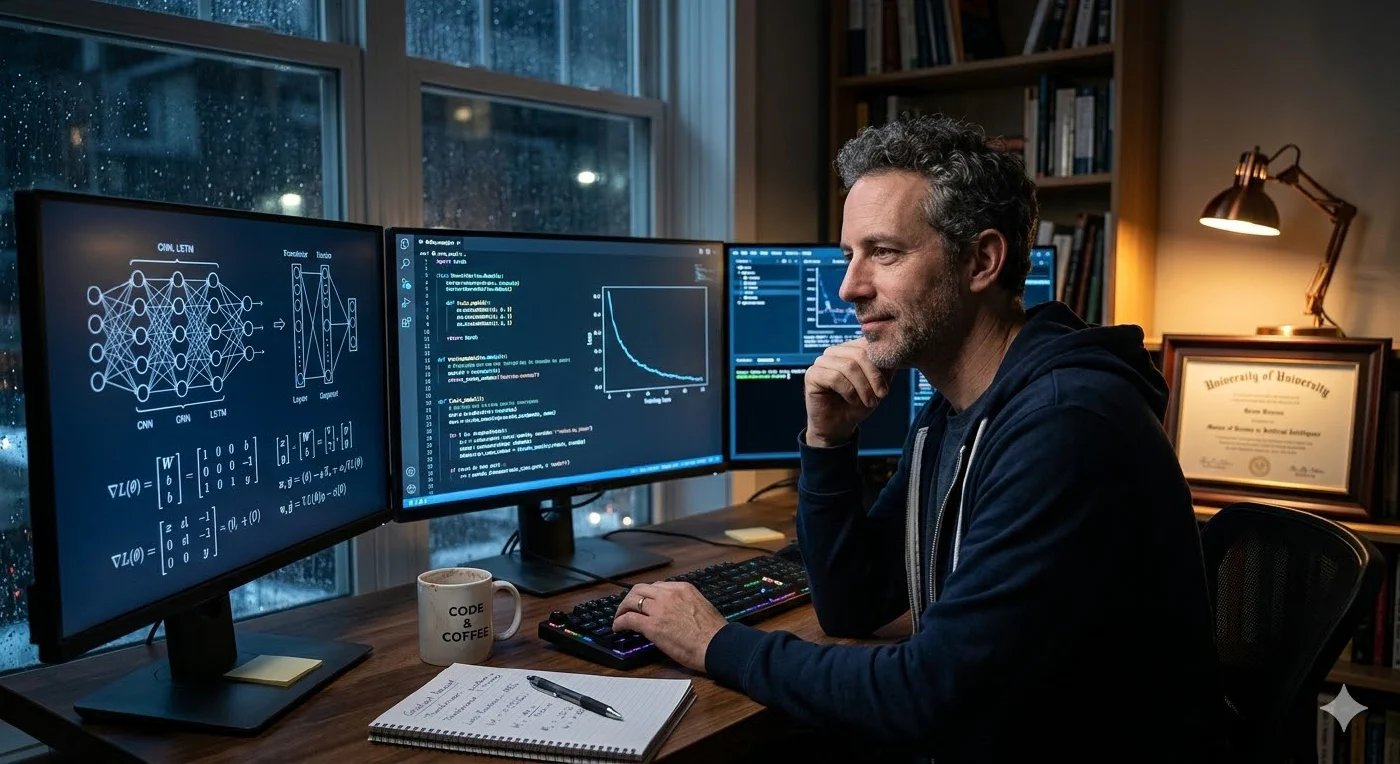
✨ The Certification Just Arrived!
I just received word from Alyra – I’ve officially completed the AI Developer Certification, successfully mastering the fundamentals of Machine Learning and Deep Learning! 🎉
These past three months have been nothing short of transformative. Not just technically, but personally too. This certification represents far more than finishing a course — it’s about rediscovering mathematics, overcoming personal challenges, and proving to myself that I can learn deeply, even when everything feels impossible.
📚 Why This Certification Matters
With over 20 years of experience as a Python developer, I thought I had plateaued in terms of learning. I was wrong.
AI and machine learning represent a fundamental shift in how we can approach problem-solving. It’s not about libraries or frameworks anymore — it’s about understanding data, probability, linear algebra, and neural networks from first principles.
This certification showed me that:
- 🧮 Mathematics is still relevant — vectors, matrices, cosines, sines, and geometry all matter
- 🤖 Deep learning can solve problems we never thought possible
- 🔍 Understanding the theory makes you exponentially better at applying the tools
- 💪 Growth comes from struggle — especially when you’re learning something completely new
🏋️ The Training Itself
- Official Title: AI Application Developer with Big Data Analytics
- Certification: RNCP38616 (Level 6 – Bachelor’s degree equivalent)
- Provider: Alyra
- Duration: 120 hours over 12 weeks (September – December 2025)
- Format: Evening classes, Monday to Thursday (officially 2–3 hours per night), 100% remote
- Reality: Much closer to 8 hours per day when you factor in daily project development
The numbers don’t tell the real story. Here’s what happened:
- Evenings: Attend live courses on ML/DL theory and best practices
- Nights: Work on challenging projects to solidify understanding
- Mornings: Refresh mathematics fundamentals (haven’t touched these seriously in years!)
It was intense. I’m grateful I didn’t have a parallel consulting mission — I honestly don’t think I could have managed both.
🔧 What I Learned
The Foundation
- Linear algebra, probability theory, and geometry
- Activation functions, backpropagation, optimization algorithms
- Data preprocessing, feature engineering, normalization
The Craft (Machine Learning – Block 03)
This is where the magic starts. You learn to look at a problem and ask yourself: “Which algorithm would be the right fit here?” Regression for continuous predictions, classification for categories, clustering when you don’t even know what you’re looking for yet.
But choosing an algorithm is just the beginning. The real work lies in preparing your data — cleaning, transforming, normalizing — because garbage in, garbage out. Then comes the dance of training: tweaking hyperparameters, fighting overfitting, celebrating when your validation metrics finally improve.
I built models from scratch, watched them fail spectacularly, debugged them, and watched them succeed. That cycle — failure, understanding, iteration — is where learning happens.
The Deep Dive (Deep Learning – Block 05)
If Machine Learning is the craft, Deep Learning is the art form. Here, you’re no longer dealing with clean, structured tables. You’re feeding raw images, text, and audio into neural networks and hoping they’ll find patterns your human brain could never spot.
I explored the architectures that power modern AI:
- CNNs for computer vision — teaching machines to “see” images
- RNNs and LSTMs for sequential data — understanding time and context
- Transformers and BERT — the attention mechanisms behind today’s language models
The final piece? Deployment. Because a model sitting in a Jupyter notebook is just a prototype. Learning to package models with FastAPI, monitor their performance in production, and apply MLOps best practices — that’s what turns a data scientist into an AI engineer.
The Humility
I realized how much I didn’t know. Even with 20 years of programming experience, diving into ML exposed gaps I wasn’t aware of. That’s growth.
💔 The Hardest Part
This certification came with unexpected challenges.
Just a few weeks before my final presentation, my grandmother suffered a stroke. She was hospitalized, and shortly after, she passed away on December 5th.
During those final weeks, I was juggling:
- Mourning a family member I loved deeply
- Completing two major ML/DL projects under strict deadlines
- Maintaining my family commitments (my wife and daughter supported me through it all)
I remember the night before my presentation — going to bed at 3-4 AM for two straight weeks, making sure every line of code was correct, every model was trained, every slide was polished. I was running on fumes and grief.
But I completed it. And I’m proud of that.
🙏 Gratitude
This certification isn’t mine alone. I want to acknowledge:
My family:
- My wife and daughter — for their unconditional support, patience, and love when everything felt overwhelming
- My grandmother Gramy — this certification is dedicated to her memory
My cohort:
- Ségolène, who graciously swapped her presentation slot so I could have an extra day
- Kenza and Safia, for their understanding and support through the difficult time
- All my classmates for creating an encouraging, collaborative environment
Alyra Team:
- My instructors and the entire Alyra community for being human about my situation
- They didn’t just push deadlines — they listened, they understood, and they helped me grow
🚀 What’s Next?
On the job market now, you have:
- ✅ Senior Python Developer (20+ years of hands-on experience)
- ✅ Certified Blockchain Developer (trained with Alyra earlier in 2025)
- ✅ Certified AI Developer (Machine Learning & Deep Learning fundamentals)
This certification has given me a much deeper understanding of machine learning, deep learning, and the broader AI landscape — from neural network architectures to the emerging world of AI agents. I’m eager to keep exploring and sharpening my skills in these areas, combining my 20+ years of Python expertise with this growing knowledge of artificial intelligence.
But beyond the job market, this certification reminded me something important: You’re never too experienced to be a beginner again.
If you’re working on ML/AI projects or looking for someone who combines deep Python expertise with fresh AI fundamentals, let’s talk. 🤝